
ACL/TKR Post-Op Physiotherapy Rehab
ACL/TKR Rehabilitation at DakshinRehab
What is ACL/TKR rehabilitation? ACL (Anterior Cruciate Ligament) and TKR (Total Knee Replacement) rehabilitation is a structured program to restore knee function after surgery, combining prehab, early post-operative care, and progressive strengthening. What challenges do patients face after ACL/TKR surgery? Post-surgery recovery feels overwhelming—weakness, pain, fear of re-injury. Every step hurts. Simple tasks become impossible. You're desperate to return to normal life, but progress feels slow and uncertain. How does DakshinRehab help? At DakshinRehab Moosapet, Hyderabad, we transform this struggle into strength. Prehab reduces atrophy and restores activation before surgery. Early post‑op care controls pain/swelling and re‑activates the quadriceps safely using Wireless Pro NMES with EMG biofeedback. We then build strength and motor control using Redcord Neurac suspension therapy and supervised home work to speed a confident, symmetrical return to function. What makes our program different? Your recovery journey starts here—with proven protocols, cutting-edge technology, and a team that understands exactly what you're going through.
How Our Integrated ACL/TKR Program Works
- Prehab protocol: Activation + strength to reduce post‑op deficits before surgery
- Early quadriceps activation: Wireless Pro NMES breaks muscle inhibition in weeks 0-4
- EMG biofeedback: Surface EMG coaches correct muscle timing and activation patterns
- Pain management: Swelling control and safe ROM milestones to protect healing
- Movement protection: Brace, gait aids, and movement patterns to prevent re-injury
- Progressive strengthening: Stage-based loading from isometrics to plyometrics
- Functional retraining: Gait and stairs retraining with sport-specific functional drills
- Return-to-sport testing: Symmetry testing using 3D gait analysis and hop tests
- Supervised home program: Clinic sessions + supervised home carryover for faster results
- Team approach: Interdisciplinary, goal‑driven reviews with specialists at our Moosapet facility
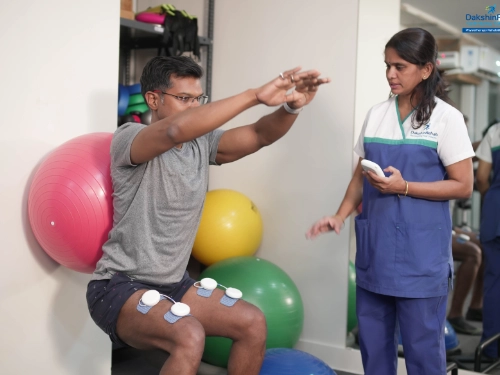
"Typical NMES block: 10–20 minutes of NMES‑assisted work within a 30–40 minute therapy session, paired with task‑specific practice."
World-Class Rehabilitation Technology Protocol
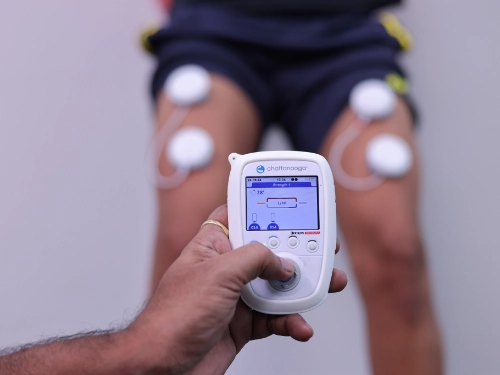
How does our technology protocol work? DakshinRehab combines cutting-edge non-surgical and post-surgical technologies at our Moosapet, Hyderabad facility. We use Chattanooga Wireless Pro NMES with EMG biofeedback, Redcord Neurac suspension therapy, Chattanooga Radial Shockwave, Tecar deep diathermy, DTS 360 spinal decompression, and Cryoflow cryotherapy to deliver faster, evidence-based recovery outcomes.
Precision Assessment
MyoPlus 4 EMG biofeedback and 3D gait analysis identify muscle activation deficits, timing issues, and asymmetries to guide personalized treatment.
Neuromuscular Activation
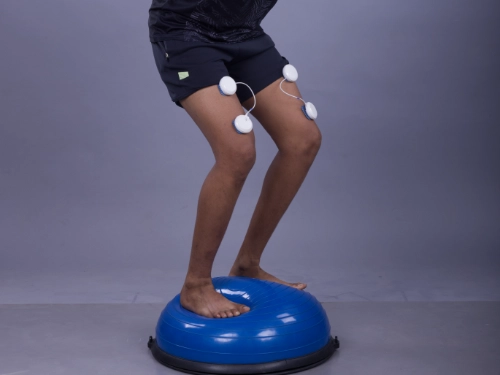
Wireless Pro NMES with real-time EMG feedback activates inhibited muscles post-ACL/TKR, overcoming early shutdown and building functional strength with task-specific movements.
Movement Retraining
Redcord Neurac suspension therapy and clinical Pilates restore pain-free deep stabilizer activation, coordination, and closed-chain control for spine, shoulder, hip, and knee rehab.
Tissue Optimization
Chattanooga Shockwave for chronic tendons, Tecar diathermy for healing acceleration, DTS 360 spinal decompression for disc pain, and Cryoflow for swelling control—integrated for maximum recovery speed.
EVIDENCE-BASED POST-SURGICAL & NON-SURGICAL REHABILITATION
World-Class Technology PortfolioWhat technologies does DakshinRehab use? DakshinRehab is Hyderabad's first center in Moosapet to integrate Chattanooga Wireless Pro NMES with EMG biofeedback, Salus Talent Pro 3 Tesla electromagnetic therapy (RPMS), Chattanooga radial shockwave, Redcord Neurac suspension, Tecar capacitive/resistive diathermy, DTS 360 spinal decompression, clinical Pilates, and Cryoflow cryotherapy. What conditions do we treat? These technologies deliver faster, evidence-driven recovery for ACL/TKR, shoulder injuries, spine conditions, and neurological conditions. Are these treatments safe? Every protocol is research-backed, FDA-cleared, and customized to your goals at our Moosapet, Kukatpally facility.
EVALUATE
Set targets (e.g., quad activation, glute timing, scapular control)
CONFIGURE
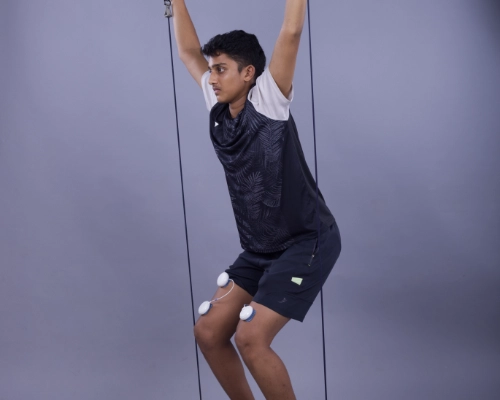
place electrodes, select parameters (strength vs. re‑ed), set work/rest cycles for quality contractions
TRAIN
practice task‑specific movements with and without NMES assistance; use EMG feedback to correct timing and effort
ASSISTANCE
10–20 minutes of NMES‑assisted work within a 30–40 minute therapy block
ACL/TKR Rehabilitation Phase Progression
Our structured 4-phase ACL/TKR rehabilitation program integrates Wireless Pro NMES with EMG biofeedback, progressive loading, and functional retraining to overcome post-operative muscle inhibition and restore optimal knee function.
Phase 1: Early Activation (Weeks 0–4)
Overcome quadriceps shutdown with daily NMES + EMG biofeedback. Focus: regain voluntary activation, reduce swelling with Cryoflow, gentle ROM exercises. Goal: achieve 90° flexion, straight-leg raise without lag, minimal pain/swelling.
Phase 2: Strength Building (Weeks 4–12)
Progress to closed-chain exercises (mini-squats, step-ups) with NMES assistance. Integrate Redcord Neurac for pain-free stabilizer activation. Goal: eliminate quad lag, achieve symmetric single-leg stance, return to stairs/daily activities.
Phase 3: Power & Symmetry (Weeks 12–20)
Add plyometric drills (box jumps, bounds) with EMG symmetry tracking. Use 3D gait analysis to identify and correct asymmetries. Goal: <10% limb symmetry index deficit in strength and hop tests, controlled cutting/pivoting.
Phase 4: Return to Sport (Weeks 20+)
Sport-specific drills with functional movement testing. Final clearance includes strength testing, hop battery, psychological readiness assessment. Maintenance: supervised gym program with periodic check-ins to prevent re-injury.
Why Early NMES + Progressive Loading Works
What is arthrogenic muscle inhibition? Post-ACL/TKR surgery triggers 'arthrogenic muscle inhibition'—your nervous system shuts down the quadriceps to protect the joint. How does Wireless Pro NMES help? Wireless Pro NMES with EMG biofeedback breaks this cycle in weeks 0–12 by delivering strong, repeatable contractions while teaching your brain to recruit the right muscle at the right time. What does research show? Multiple randomized trials confirm that early NMES improves quadriceps activation and strength versus exercise alone. What are the results? When combined with our staged loading protocol (isometrics → closed-chain → plyometrics) and Redcord Neurac suspension therapy for whole-body control, patients achieve symmetric strength and return to sport 30–40% faster with lower re-injury risk at our Moosapet, Hyderabad facility.
Example:
Clinical evidence: ACL patients using NMES in weeks 0–12 show 25–35% greater quadriceps activation and faster return to functional milestones compared to exercise-only rehab. Our protocol integrates NMES, EMG biofeedback, Redcord, and objective testing (3D gait, hop tests) to ensure each phase is mastered before progression.


Our Serving Areas
We proudly serve patients from the following areas within a 5km radius of our clinic
5km Radius
From ARD Magnum
Moosapet, Hyderabad
Convenient Location
All areas listed are within a 5km radius of our clinic at ARD Magnum, Moosapet. We also provide home physiotherapy services throughout Hyderabad for patients who prefer in-home care.
ACL/TKR Rehab FAQs
Practical, patient-friendly answers to the most common post-surgical rehab questions.